Odds of Getting Pregnant: 1 in 5 Per Month Is A Good (High) Guess
Originally posted June 29, 2023
Getting pregnant is hard! Lots of things have to go right for a pregnancy to happen and a baby to be born. A woman has to ovulate and release an egg with a viable set of chromosomes. That egg has to be met with a similarly viable sperm. Then the tiny embryo has to make its way to the uterus, implant in the uterine wall, and successfully grow into a viable baby.
Each one of those steps is hard, indeed miraculous in its own way. No wonder pregnancy in any given month is not a sure thing. But often times ladies seem to think if they just “do the right thing” pregnancy is assured. And that failure to get pregnant quickly means there must be “something wrong”. As described below, research shows that pregnancy odds per cycle are usually around one in five at most. And most of the studies that estimate these odds are based on heterosexual women with (generally) ready access to ample sperm. If anything that might overstate the odds for women using informal sperm donor methods. So if you don’t get pregnant immediately, or even after three cycles, don’t freak out. Probably nothing is wrong, particularly if you are relatively young and are using a donor with recent successes.
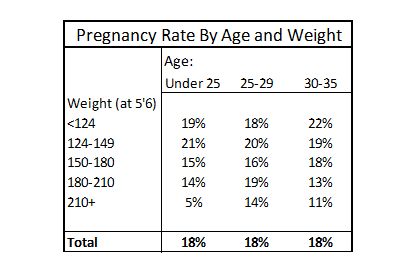
Let’s take a look at some academic studies. “An internet-based prospective study of body size and time-to-pregnancy” followed two-thousand partnered heterosexual ladies who were attempting to get pregnant. The study was primarily concerned with whether being overweight affects the amount of time it takes to get pregnant (“time-to-pregnancy” or TTP). They found 1149 pregnancies in 6320 cycles, which equates to a pregnancy rate of 18.2%. Pregnancy rates were between 17.6%-18.5% per cycle for all three age groups they considered (20-24,25-29,30+) and somewhat lower at very high BMIs, though not radically so. The authors noted that “after 6 and 12 cycles of pregnancy attempts, 51.8 and 69.6% of cohort members reported a pregnancy, respectively”. So half of the ladies got pregnant in six months. Nearly one in three was not pregnant after a full year.
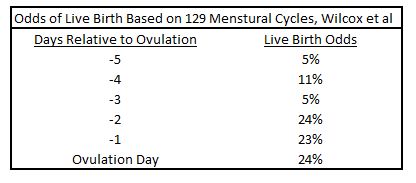
In “Timing of Sexual Intercourse in Relation to Ovulation”, Wilcox et. al found 129 live births in 625 cycles, for a live birth rate of 20.6%. This is somewhat above that found in the other study above, considering that some detected pregnancies miscarry or go chemical. This higher pregnancy rate might be explained by the fact that the authors specifically excluded unhealthy women or anyone with a history of infertility, and also had a relatively young study group (80% were under the age of 35). As the title implies, this study also looked at what day it is best to inseminate and found that odds are much higher if insemination happens within two days of ovulation. They note that “most ovulatory menstrual cycles (an estimated 63 percent in our study) may be incapable of producing a conception”. Combining this, with their estimate that 1/3 of conceptions end prior to live birth, produces a possible live birth rate of 25% even with perfect timing amongst healthy, predominantly young women, most of whom had already had a child.
In “Double intrauterine insemination (IUI) of no benefit over single IUI among lesbian and single women seeking to conceive” researchers found that both lesbians and heterosexual couples have around a 17% chance of getting pregnant in the IUI procedure. Interestingly, it took the lesbians only one attempt per cycle to achieve this (maximum) success rate, while the heterosexual couples required two treatments. This might be because many of the male partners in the straight couple IUIs had poor sperm, and thereby benefited from additional attempts. Incidentally, IUI is similar to what is known as “AI” or ICI in the sperm donor world, except that ladies using informal donors insert in the vagina instead of past the cervix. Home donation might therefore be somewhat less effective, though the loss of sperm not getting through the cervix in ICI may be somewhat offset by the generally higher sperm counts in whole fresh donations, compared to frozen sub-divided ones.
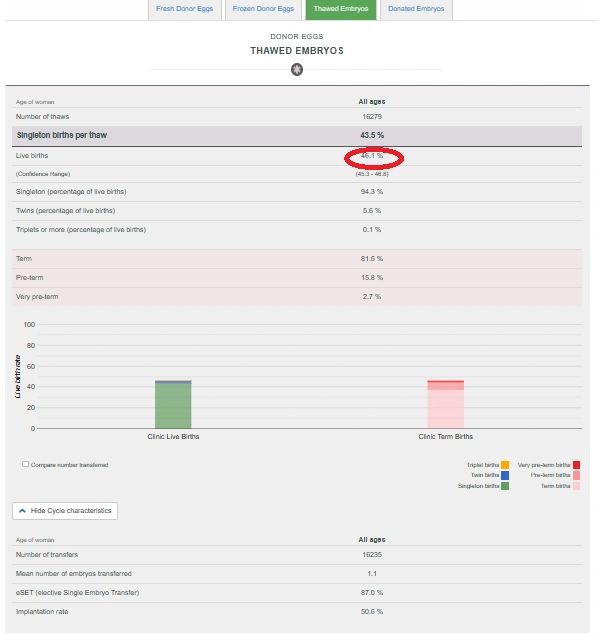
Another way to think about pregnancy odds is by examining in-vitro fertilization. With IVF cycles, fertilization and initial embryo growth happens in the lab. Embryos are grown for between three and five days in a petri dish, going from just one to around one hundred cells. They are then transferred into the uterus. If pregnancy was easy, then nearly all embryo transfers should result in a live birth right? After all, the part that most ladies seem to think is the constraint – having enough sperm to meet the egg – has already happened. But that isn’t what happens at all. In the latest data, only 46% of embryo transfers (from fertile donor eggs) resulted in a live birth. So even with a successful fertilization, an embryo healthy enough to grow to a hundred cells, and placement of said embryo close to where it needs to be, success is still a coin flip at best. Non-ivf pregnancy odds will necessarily be much below that.